Turning Your Tax Refund into a Down Payment: How Much Do You Actually Need?
Every spring, thousands of car shoppers across the Bronx and Westchester County find themselves sitting on a tax refund and wondering the same thing: is this enough to put down on a vehicle? The answer depends on more than just the dollar amount. It depends on the car you choose, the loan term you accept, and whether you understand the financial rules that separate smart buyers from overextended ones.
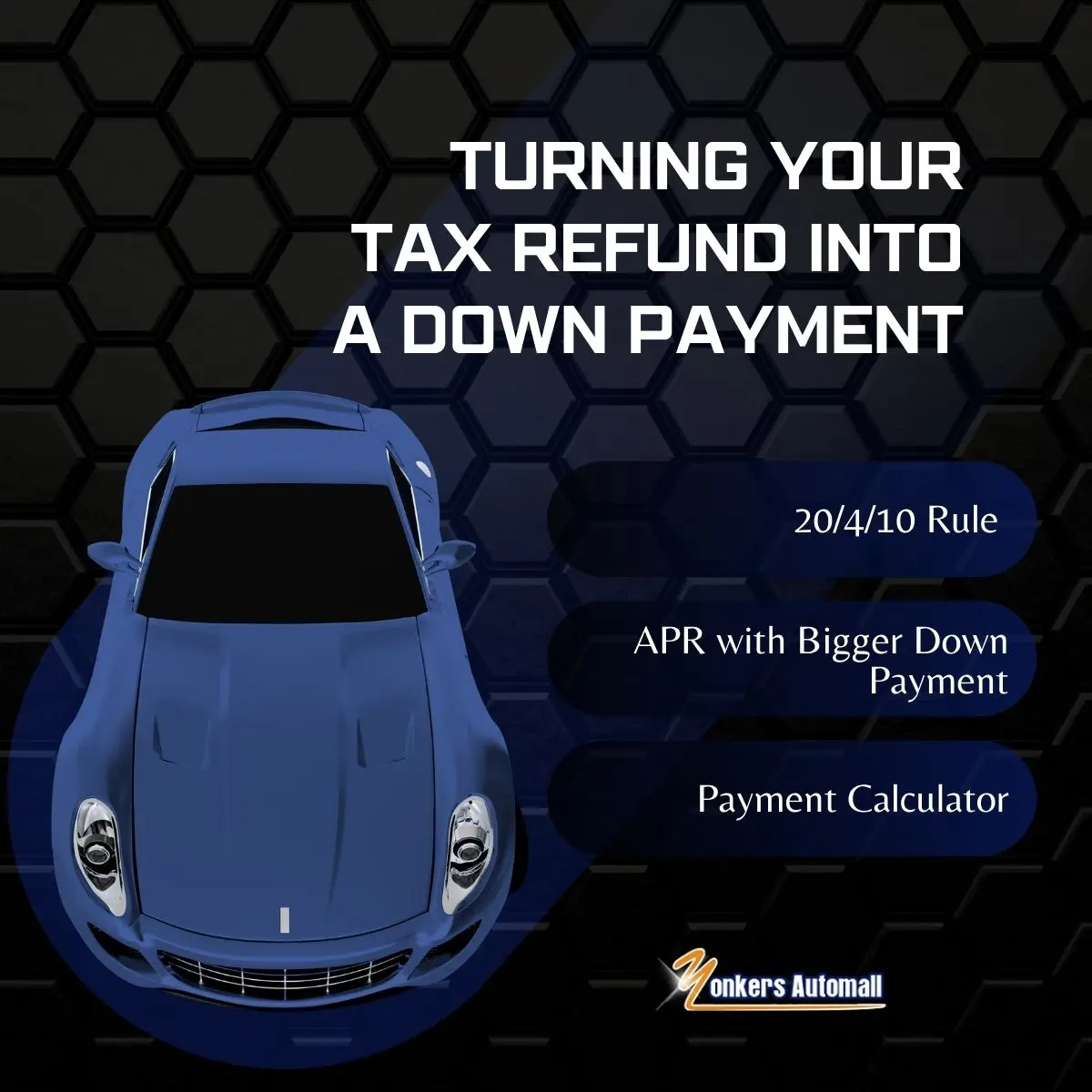
This post covers the 20/4/10 Rule of car buying, how your down payment directly affects your APR and monthly costs, and how to use a payment calculator to plan ahead before visiting any Bronx car dealerships in 2026.
What Is the 20/4/10 Rule and Why Does It Still Matter?
The 20/4/10 Rule is a personal finance guideline that has held up well for decades because it keeps car payments from crowding out other financial priorities. Here is how it breaks down:
- 20% down on the purchase price
- 4 years (48 months) or fewer on the loan term
- 10% of your gross monthly income as the ceiling for your total monthly transportation cost, including insurance
According to Investopedia's breakdown of car down payments, putting down 20% helps you avoid being underwater on your loan, which means owing more than the car is worth. This matters especially with used cars, which depreciate at different rates depending on make, model, mileage, and condition.
Applying the Rule to Real Numbers
Say you are shopping for a used vehicle priced at $22,000. Applying the 20/4/10 Rule looks like this:
- 20% down = $4,400
- Loan amount = $17,600
- At a 7% APR over 48 months, your estimated monthly payment is approximately $421
- You would want your gross monthly income to be at least $4,210 for this to fit within the 10% guideline
If your tax refund is $3,000 to $5,000, you are in a strong position to meet or approach that 20% threshold on a moderately priced used vehicle.
How a Larger Down Payment Affects Your APR
This is where many buyers leave money on the table. A larger down payment does not just reduce what you borrow. It can meaningfully improve the interest rate a lender offers you.
Lenders use loan-to-value (LTV) ratio as one factor in pricing your loan. When you put more down, the LTV drops, which signals lower risk. In practical terms, this can mean the difference between qualifying at 8.9% APR versus 6.4% APR. Over a 48-month term on an $18,000 loan, that difference is roughly $900 in extra interest paid.
Here is a comparison to illustrate:
| Down Payment | Loan Amount | APR (estimated) | Monthly Payment (48 mo) | Total Interest Paid |
|---|---|---|---|---|
| 10% ($2,200) | $19,800 | 8.5% | $489 | $3,672 |
| 20% ($4,400) | $17,600 | 6.9% | $421 | $2,608 |
| 25% ($5,500) | $16,500 | 6.4% | $391 | $2,268 |
The takeaway is clear: a larger upfront investment shrinks your loan, lowers your rate, and reduces total interest. Your tax refund is one of the best annual opportunities to make this move.
Using a Payment Calculator to Forecast Your 2026 Expenses
Before you visit any dealership or browse used cars for sale near the Bronx, spend 10 minutes with a payment calculator. It gives you a realistic picture of what a vehicle will cost monthly so you are not surprised at the finance table.
Our Payment Calculator at AutoMall Yonkers lets you input the vehicle price, your estimated down payment, loan term, and interest rate. You can test different scenarios instantly.
What to Test Before You Shop
- Conservative scenario: Put down your full refund, choose a 48-month term, and see if the payment fits within 10% of your monthly gross income.
- Stretch scenario: Put down less to keep more cash in reserve. See how much the payment climbs and whether you can still afford insurance and fuel comfortably.
- Aggressive payoff scenario: Try a 36-month term. Payments will be higher but total interest drops significantly.
Insider Tips That Do Not Show Up on Manufacturer Pages
Working with buyers across the greater Bronx area, a few patterns come up consistently among first-time and returning car buyers:
- Certified Pre-Owned (CPO) vehicles offer a middle path. CPO vehicles, which must pass manufacturer inspections and come with extended warranties, often carry lower financing rates than standard used cars.
- Gap insurance becomes less necessary. If you put down 20% or more, you are less likely to be underwater on your loan. Knowing this can save you $400 to $800 over the life of the loan.
- Season matters. Tax season (February through April) is historically one of the stronger periods to buy because dealers are working through Q1 inventory.
- Your trade-in and your refund work together. Combining equity with your tax refund as a single down payment can easily push you past the 20% threshold.
Ready to Run Your Numbers?
If you are exploring used cars for sale near the Bronx or want to understand your financing options, the team at AutoMall Yonkers is here to help with transparent, pressure-free guidance.
Start with our Payment Calculator to map out your 2026 budget. When you are ready to talk financing, our Finance Center connects you with options that fit your income, credit profile, and goals.
Your tax refund is a real opportunity. Used wisely, it can be the key to a better rate, a lower payment, and a vehicle you feel confident about for years to come.
Explore Financing Options